
Every car flipper needs a reliable source of inventory. The platform where you buy determines your margins, your risk, and how quickly you can turn vehicles. In 2026, three platforms dominate the car-flipping landscape: Facebook Marketplace for private-party deals, Copart for insurance auction vehicles, and IAAI (Insurance Auto Auctions) for another major slice of the salvage and clean-title auction market.
Each platform has a fundamentally different risk-reward profile. Facebook Marketplace gives you zero-fee access to running, inspectable vehicles from private sellers. Copart and IAAI give you access to below-market pricing on insurance write-offs, repossessions, and fleet disposals — but with buyer fees, transport costs, and the inability to test drive before you bid. Choosing the right platform (or combination of platforms) for your situation is one of the most consequential decisions you will make as a flipper.

Three Main Sources for Flip Inventory
Before diving into each platform, here is a quick orientation. These three sources serve different segments of the used car market:
- Facebook Marketplace: Private sellers listing their personal vehicles. Prices reflect retail or near-retail expectations, but motivated sellers frequently list below market value. No buyer fees. You see and drive the car before buying.
- Copart: The largest online vehicle auction platform in the U.S., handling insurance total losses, dealer trade-ins, fleet vehicles, and repossessions. Vehicles range from pristine clean-title cars to heavily damaged salvage units. Buyer fees apply to every purchase.
- IAAI (Insurance Auto Auctions): The second-largest vehicle auction platform, with a similar inventory mix to Copart but with different fee structures and a strong pipeline of insurance-company consignments. Owned by IAA, which merged with Ritchie Bros. in 2023.
Most successful high-volume flippers use at least two of these three sources. But if you are starting out, understanding each platform's strengths and weaknesses will help you focus your time and capital where they will produce the best returns.
 Facebook Marketplace Deep Dive
Facebook Marketplace is the largest peer-to-peer vehicle marketplace in the United States. Millions of cars are listed every month by private sellers, small dealers, and individuals looking to quickly offload a vehicle. For car flippers, it is the most accessible and lowest-risk source of inventory available.
Pros
- Zero buyer fees: Unlike auction platforms, there is no premium, no buyer fee, no gate fee, and no internet bidding fee. The price you negotiate is the price you pay. This alone can save $300-$1,000+ per vehicle compared to auction purchases.
- Inspect before you buy: You can see, touch, drive, and have a mechanic inspect the vehicle before committing a dollar. This eliminates the single biggest risk of auction buying — getting a car that is worse than described.
- Private sellers price emotionally: Many private sellers have no idea what their car is worth. They price based on what they paid for it, what they need to buy their next car, or simply what "feels right." This creates regular opportunities to buy significantly below market value — especially from motivated sellers who need the car gone quickly due to a move, a new purchase, financial pressure, or a divorce.
- Direct negotiation: You message the seller directly, which means you can probe for motivation, negotiate aggressively when appropriate, and close the deal on your own timeline. There is no bidding war driving the price up in the final seconds.
- Local pickup: No transport costs. You drive the car home or tow it locally for a fraction of what cross-country auto transport costs from an auction yard.
- Speed: You can find, inspect, buy, and take possession of a vehicle in a single day. Auction purchases typically take 3-7 business days after winning the bid before you can pick up the vehicle, plus transport time if the auction yard is not local.
Cons
- Competition from other flippers: The best deals disappear fast — often within one to three hours. If you are manually browsing, you are competing against flippers using automated monitoring tools who see new listings the moment they appear.
- Scams and misrepresentation: Some sellers hide known issues, roll back odometers, or sell vehicles they do not legally own. Always run a VIN check, verify the title, and inspect in person before buying.
- Inconsistent quality: There is no standardized condition reporting. Seller descriptions range from brutally honest to wildly misleading. You have to develop your own evaluation process and be prepared to walk away from vehicles that do not match the listing.
- Volume limitations: Finding underpriced vehicles on Marketplace requires consistent effort. Without automated alerts, you may spend hours browsing and messaging sellers with nothing to show for it on a given day.
Best For
Facebook Marketplace is ideal for beginners, quick-flip operators, and anyone targeting specific makes and models. If you want to buy a running 2012 Honda Civic for $4,000 and sell it for $6,500 two weeks later with a detail and minor cosmetics, Marketplace is your platform. It is also the best option for flippers without a dealer license, since there are no access restrictions or registration requirements.

 Never Miss an Underpriced Listing on Facebook Marketplace
CarSnipe monitors Facebook Marketplace around the clock and sends instant  Telegram alerts when vehicles matching your criteria appear. Be the first to message the seller — before other flippers even see the listing.
install CarSnipe and compare the timing first-hand · View pricing
 Copart Deep Dive
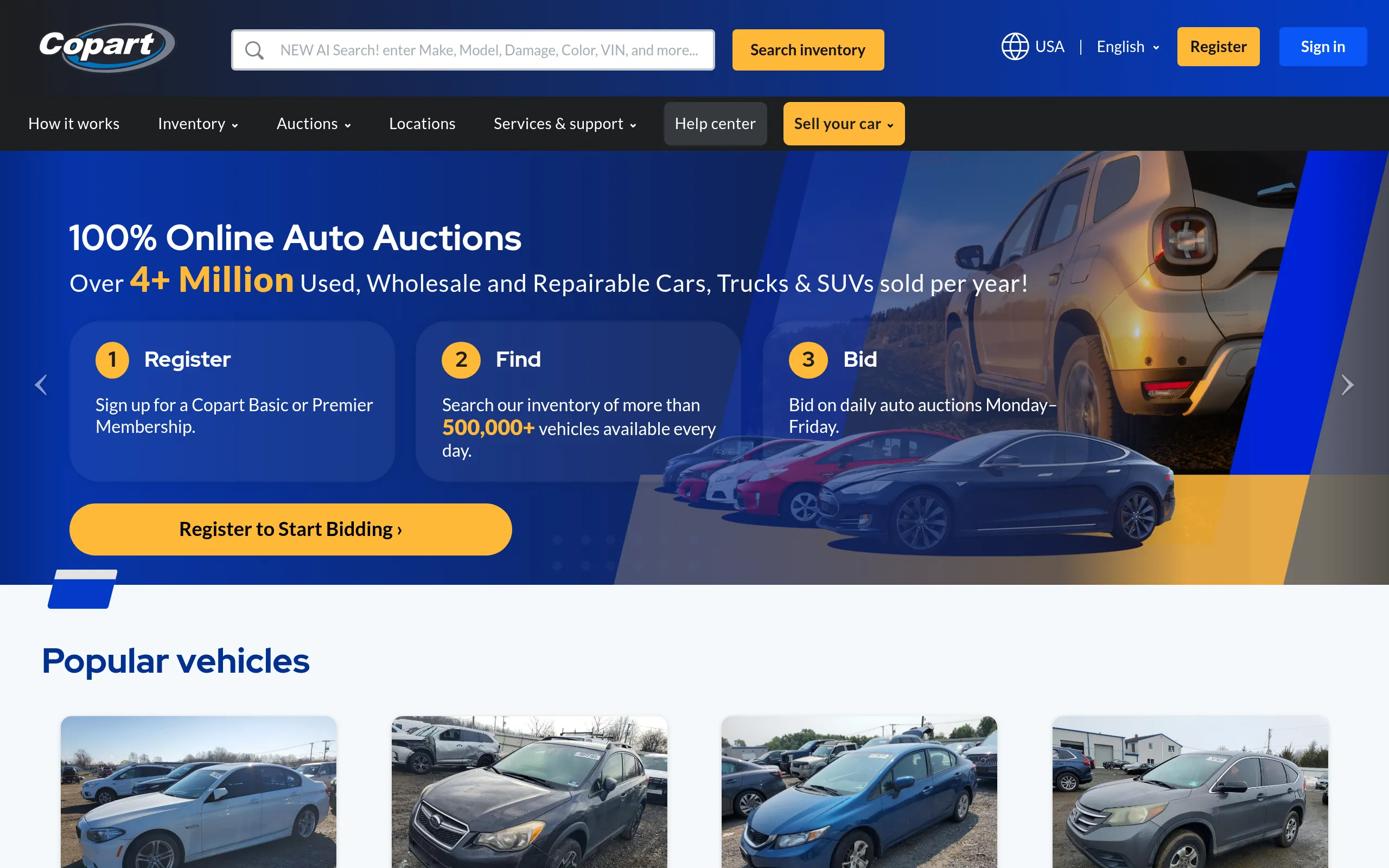
Copart is the world's largest online vehicle auction platform, with over 200 locations across the U.S. and operations in 11 countries. They process over 4 million vehicles annually, ranging from clean-title fleet disposals to heavily damaged salvage units. For experienced flippers, Copart provides access to a massive pool of below-market vehicles that are not available anywhere else.
Pros
- Massive inventory: On any given day, Copart has 200,000+ vehicles available for bidding. This includes every make, model, and condition imaginable — from pristine low-mileage cars to flood-damaged trucks to exotic sports cars with minor fender damage.
- Below-market pricing: Insurance companies and fleet operators use Copart to liquidate vehicles at wholesale prices. The hammer price on many vehicles is 30-60% below retail market value, which creates significant margin potential for flippers who know how to evaluate condition and estimate repair costs accurately.
- Clean AND salvage titles: While Copart is known for salvage vehicles, a significant portion of their inventory carries clean titles. These include dealer trade-ins, rental fleet disposals, repossessions, and donation vehicles. Clean-title Copart vehicles are often the best value in the flipping world — below-market pricing without the stigma of a salvage or rebuilt title.
- Detailed vehicle information: Each listing includes photos (usually 10-20+), damage descriptions, odometer readings, title type, and a condition grade. While this does not replace an in-person inspection, it gives you substantially more information than a typical Marketplace listing.
- Online bidding: You can bid from anywhere. No need to physically attend an auction. This opens up inventory from every Copart yard in the country, not just your local one.
Cons
- Buyer fees are significant: Copart charges a tiered buyer premium that varies by sale price. For vehicles in the $1,000-$5,000 range (common flip targets), expect to pay $300-$700 in buyer fees. Higher-priced vehicles incur proportionally larger fees. There are also gate fees, environmental fees, and virtual bidding fees that add up. Budget an additional 15-25% on top of the hammer price for total buyer costs.
- Access restrictions: While Copart offers public (Member) accounts, many states restrict public buyers from purchasing salvage-title vehicles. To access the full inventory with the lowest fees, you need a dealer license or a broker account. Some flippers use third-party broker services, but these add another layer of fees.
- You cannot test drive: Vehicles at Copart are sold as-is with no warranty and no opportunity to start the engine, drive the car, or have a mechanic inspect it before bidding. You are relying entirely on photos, the condition report, and your own ability to assess damage from images. This is where inexperienced buyers get burned.
- Transport costs: Unless you live near a Copart yard and only buy from that location, you will need to arrange transport. Shipping a vehicle across several states can cost $300-$800+, which directly impacts your margins. Even towing from a local yard typically costs $75-$200.
- Storage fees: Copart charges daily storage fees if you do not pick up or arrange transport within a few business days of winning the auction. These fees accumulate quickly and can erode your profit if you are slow to act.
Best For
Copart is best for experienced flippers who can accurately assess vehicle condition from photos, salvage rebuilders who have the skills and shop space to repair damaged vehicles profitably, and parts-car operators who buy wrecked vehicles to part out for more than the purchase price. If you have a dealer license, Copart becomes significantly more profitable due to lower fees and full inventory access.
 IAAI Deep Dive
IAAI (Insurance Auto Auctions) is the second-largest vehicle auction platform in the U.S., operating over 200 locations. After merging with Ritchie Bros. in 2023, IAAI has expanded its reach and technology while maintaining its core strength: deep relationships with insurance companies that generate a steady stream of total-loss and recovered-theft vehicles.
Pros
- Strong insurance-company inventory: Several major insurance carriers have exclusive or preferred consignment agreements with IAAI. This means certain vehicles — particularly late-model total losses with relatively minor damage — show up on IAAI before (or instead of) Copart. If you are targeting insurance write-offs, IAAI often has better selection in certain regions and vehicle categories.
- Slightly less competitive on some vehicles: Because Copart has more brand recognition and a larger international buyer base, popular vehicle models sometimes attract fewer bidders on IAAI. This is not universal, but experienced auction buyers frequently find better deals on IAAI for specific makes and models, particularly domestic brands and trucks.
- Buy Now option: IAAI offers a "Buy Now" feature on select vehicles, allowing you to skip the auction process entirely and purchase at a fixed price. This is useful when you find a vehicle priced within your buy target and want to avoid the uncertainty of competitive bidding.
- Clean-title inventory: Like Copart, IAAI handles a meaningful volume of clean-title vehicles from fleet operators, dealers, and financial institutions. These are often the most attractive flip targets on the platform.
- Detailed condition reports: IAAI provides comprehensive condition reports with damage photos, VIN data, and estimated repair costs on many vehicles. Their reporting has improved significantly in recent years and is competitive with Copart's listing detail.
Cons
- Buyer fee structure: IAAI's fee structure is similar to Copart's but differs in the specifics. They charge a buyer premium based on the sale price, plus additional service fees. The total buyer cost is generally comparable to Copart — expect to add 15-25% to the hammer price for fees, though the exact breakdown differs. Always calculate your all-in cost before bidding.
- Access requirements: Same as Copart — public buyers can register but face restrictions on salvage-title vehicles in many states. A dealer license provides full access and lower fee tiers.
- No test drives: Same as Copart. All vehicles are sold as-is with no opportunity to start, drive, or mechanically inspect before purchase.
- Smaller overall inventory: While IAAI is a major platform, Copart generally has more total vehicles available at any given time. In less populated areas, your local IAAI yard may have a thinner selection than the nearest Copart location.
- Transport and storage: Same logistics challenges as Copart. You need to arrange transport promptly or face daily storage fees that eat into your margins.
Best For
IAAI is best for flippers who already use Copart and want to expand their sourcing to a second auction platform. It is also strong for buyers specifically targeting insurance total-loss vehicles, where IAAI's carrier relationships may surface inventory that does not appear on Copart. If you are comparing the two auction platforms, the smart move is to search both before bidding — the same model vehicle can vary by thousands of dollars between platforms on any given week.
Head-to-Head Comparison
Here is a direct comparison across the factors that matter most for car flippers. This table assumes you are buying vehicles in the $2,000-$10,000 range, which is where most flipping activity occurs.
| Factor | Facebook Marketplace |
Copart |
IAAI |
|---|---|---|---|
| Buyer Fees | None | 15-25% of hammer price (tiered) | 15-25% of hammer price (tiered) |
| Vehicle Condition | Running, drivable (usually) | Ranges from pristine to totaled | Ranges from pristine to totaled |
| Title Types | Clean title (vast majority) | Clean, salvage, rebuilt, parts-only | Clean, salvage, rebuilt, parts-only |
| Access Requirements | Facebook account only | Free membership; dealer license for full access | Free membership; dealer license for full access |
| Competition Level | High on best deals (hours to respond) | High (large international buyer base) | Moderate to high (varies by vehicle) |
| Speed to Purchase | Same day possible | 3-7 days (bid to pickup) | 3-7 days (bid to pickup) |
| Inspection Before Buying | Yes — full inspection and test drive | No — photos and condition report only | No — photos and condition report only |
| Best For | Beginners, quick flips, specific models | Experienced flippers, salvage rebuilds | Insurance write-offs, auction comparison |
Which Platform Should You Use?
The answer depends on your experience level, your budget, and what kind of flipping you want to do.
If You Are a Beginner (0-10 Flips)
Start with Facebook Marketplace exclusively. The ability to inspect vehicles before buying eliminates the biggest risk factor in car flipping — purchasing a vehicle that needs more work than you expected. Zero buyer fees mean your margins are protected, and the direct negotiation process teaches you how to evaluate sellers, assess motivation, and close deals at favorable prices. These are foundational skills you will need regardless of which platforms you eventually expand to.
Focus on high-demand, reliable models in the $3,000-$7,000 range. Use automated monitoring tools to catch underpriced listings before other flippers, and aim for $500-$1,500 profit per flip while you build your knowledge and capital. Read our complete guide to flipping on Facebook Marketplace for the full step-by-step process.
If You Are Intermediate (10-50 Flips)
Continue using Facebook Marketplace as your primary source, but start exploring Copart and IAAI for clean-title vehicles only. Avoid salvage titles until you have the experience and mechanical knowledge to accurately estimate repair costs from photos alone. Clean-title auction vehicles — particularly fleet disposals and dealer trade-ins — offer the best risk-adjusted returns for intermediate flippers.
Register for both Copart and IAAI, set up saved searches for your target models, and spend a few weeks watching auction results before bidding. Understanding what vehicles actually sell for (versus what they are listed at) is critical before you commit capital. Make sure you understand the dealer licensing rules in your state as your volume increases.
If You Are Experienced (50+ Flips or Licensed Dealer)
Use all three platforms aggressively. With a dealer license, Copart and IAAI become significantly more profitable — lower fees, full inventory access, and the ability to buy salvage-title vehicles that public buyers cannot. Run Marketplace for your quick retail flips (these generate cash flow), and use Copart and IAAI for project vehicles with higher margin potential.
At this level, the key differentiator is deal flow — having more opportunities than you can pursue, and selecting only the highest-margin vehicles. Automated alerts on Marketplace, saved searches on Copart and IAAI, and a network of wholesale contacts keep your pipeline full.
The Hybrid Approach
The most successful car flippers in 2026 do not rely on a single sourcing channel. They use a hybrid approach that matches different platforms to different types of flips:
Facebook Marketplace for Quick Retail Flips
Use Marketplace for vehicles you can buy, detail, and resell within 1-3 weeks with minimal mechanical work. These are your cash-flow flips — they keep money moving and generate consistent income. Target underpriced listings from motivated sellers, buy below market value, clean the vehicle up, and relist at retail. Profit per flip: $500-$2,000. Turnaround: 1-3 weeks. Sourcing this way rewards whoever sees the listing first, so it is worth knowing what the tools that watch Marketplace for you cost and how fast they alert.
Copart and IAAI for Project Cars
Use auction platforms for vehicles that require more work but offer higher margins. A salvage-title Honda Accord with front-end damage that you can buy for $2,000 at auction and repair for $1,500 might sell for $7,000-$8,000 with a rebuilt title. That is a $3,500-$4,500 gross profit — but it takes 3-6 weeks of repair time and carries real risk if the damage is worse than the photos indicated.
Balancing the Two
A balanced approach might look like this: run 2-3 Marketplace flips per month for cash flow (20-30 hours of total work), and run 1 auction project car per month for higher margins (40-60 hours including repairs). The Marketplace flips generate the income you need to cover expenses and build capital, while the auction projects provide the larger paydays that accelerate your growth.
This hybrid strategy also protects you against slow periods on any single platform. If Marketplace deals dry up in your area for a week, you have auction inventory to work on. If auction prices spike on your target models, Marketplace picks up the slack.
Automate Your Facebook Marketplace Sourcing
CarSnipe scans Facebook Marketplace every 3 minutes and sends you instant Telegram alerts for vehicles matching your make, model, year, and price criteria. Stop manually refreshing listings and start getting deals delivered to your phone the moment they are posted.
read the head-to-head, then try it on your own search · View pricing
Frequently Asked Questions
Yes, Copart allows public buyers to purchase vehicles through their Member registration. However, public members face restrictions in many states — you may only be able to bid on vehicles with clean titles, and you will typically pay higher buyer fees than licensed dealers. Some states require a dealer license to purchase salvage-title vehicles from Copart. Licensed dealers get access to the full inventory, lower fee tiers, and the ability to buy in any state without restrictions.
Facebook Marketplace has zero buyer fees, making it cheaper on a per-transaction basis. However, auction platforms like Copart and IAAI often have lower hammer prices because they are selling insurance write-offs, repossessions, and fleet vehicles in bulk. Once you add Copart or IAAI buyer fees (which can range from $100 to $1,000+ depending on the sale price), the total cost may be similar to a Marketplace purchase — but the vehicle condition is usually worse at auction. For clean-title, running vehicles, Marketplace typically offers better total value.
Neither platform is universally better — it depends on what you are looking for. IAAI tends to have stronger insurance-company inventory because many major insurers have exclusive contracts with IAAI. Copart has a larger overall inventory and more international buyer participation, which can drive prices higher on popular models. Many experienced flippers use both platforms and compare pricing before bidding. If you are just starting with auctions, Copart has a slightly more user-friendly interface and more available resources for new buyers.
Facebook Marketplace is the best starting point for beginners. There are no buyer fees, no license requirements, you can inspect the vehicle in person before buying, and you can negotiate directly with the seller. This eliminates the risks that make auction buying difficult for newcomers — such as buying a car sight-unseen, paying unexpected fees, or winning a bid on a vehicle that turns out to need more work than anticipated. Once you have completed several successful flips on Marketplace and understand vehicle valuation, you can expand into Copart or IAAI for higher-margin opportunities.